
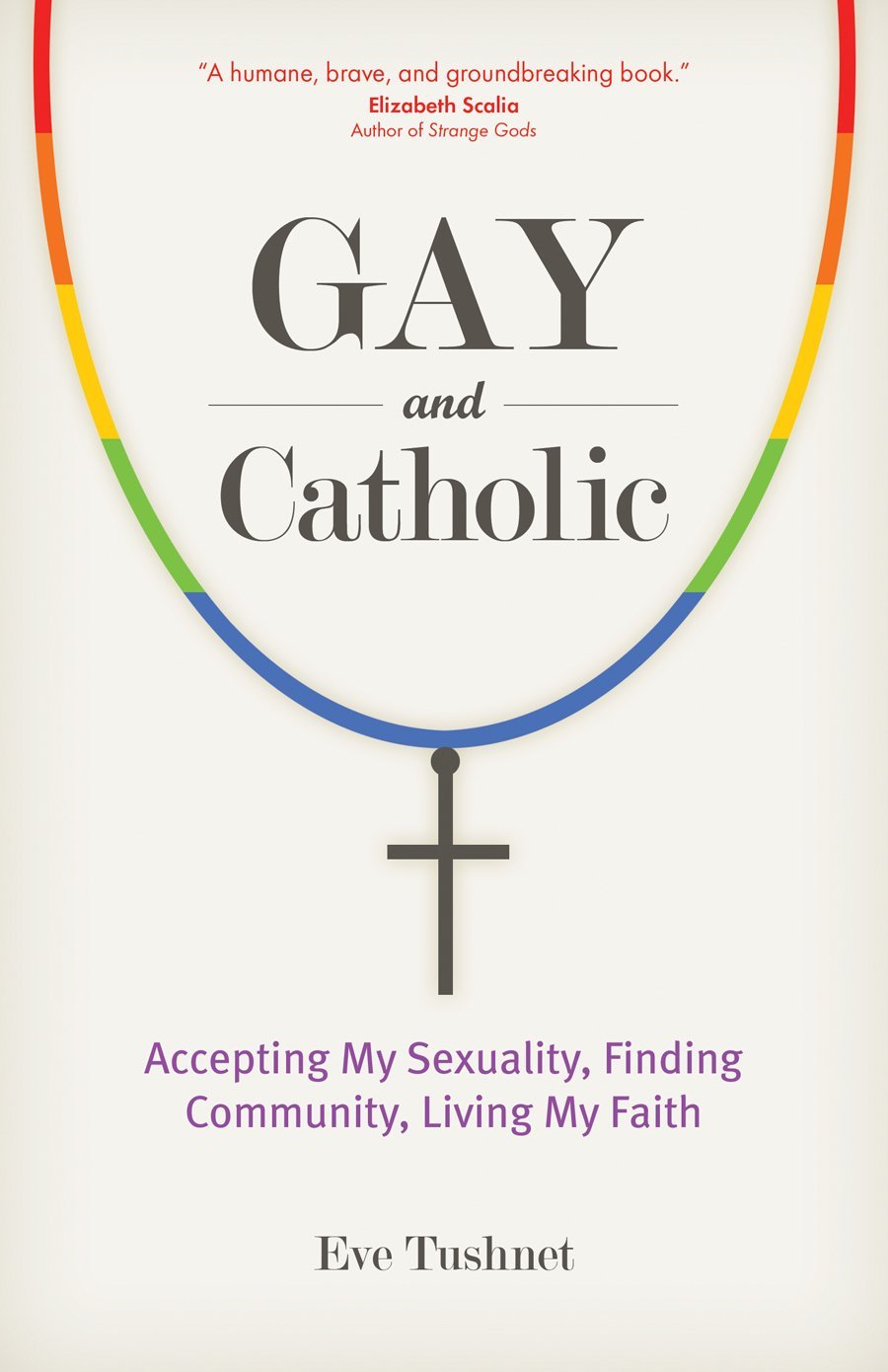
 While riding transit, I pass time by reading books about LGBTQ+ theology. My wife Danice is usually happy for me to summarize them for her afterward so she doesn’t have to read them herself, but having witnessed my frequent laughter and eager underlining as I devoured Eve Tushnet’s book, Gay and Catholic, Danice now wants to read it too. That in itself may be enough of a review.
Perhaps I was already predisposed to enjoy Eve’s book because I’m already fond of Eve. I attended one of her workshops this past January at the Gay Christian Network conference, and I was hooked by the way she unabashedly “geeked out” over historical accounts of spiritual friendship. Intelligent people often make you feel inferior, but listening to Eve just made me jealous; I wished that studying something could thrill me as much as it seemed to thrill her.
Along those same lines, I couldn’t help feeling like Eve took genuine delight in writing this book. It has more creatively crafted sentences, more literary allusions, and more of a consistent voice than any other book I’ve read in the LGBTQ+ Christian category. Reading it made me want to become a better writer. Even her rampant cat references somehow surpassed mere lesbian clichés: case in point, her confession that she associates “intentional community” with “arguments over whether the cats should go vegan.”
Part One of Gay and Catholic is Eve’s own account of coming out as a lesbian in her atheist family, falling in love with the Catholic church in college, choosing to be baptized, and then confronting her alcoholism – a story made all the more interesting because its pieces seem to be scrambled and assembled in the opposite order from your average gay Christian autobiography.
Eve has a remarkable gift for mixing incisive wit and quirky humor with mature, vulnerable introspection. At certain moments this killer combination surprises you like a swift punch to the gut – I promise, her reflections on the toy soldier figurine of her childhood will floor you. What I appreciated most about this section, besides her descriptions of her evolving outfits (“hot pink fishnets, a tiger-print skirt held together with safety pins and lies, and a Boy Scout T-shirt”), was her outspoken defense of the gay community in which she was nurtured. She debunks claims that homosexuality only produces self-centered narcissists; among her reasons for continuing to call herself gay is that “gay communities were places where [she] encountered beauty and learned solidarity and humility.” Although she is now celibate, she recounts scenes of her early lesbian relationships with a gratitude that almost approaches reverence. This stereotype-busting effort is valiant, considering her conservative audience, and I gratefully applaud her for it.
Part Two contains Eve’s thoughts about vocation, friendship, and celibate life, summed up by the aphorism “You are called to love.” Drawing from history, theology, her own life, and interviews with celibate friends, she succeeds at down-to -earth practicality in this section, and does so even further in her three appendices at the end of the book (which address Catholic theology, FAQs, and churches seeking to welcome gay people). I gleaned much from her thinking on vocation: since Eve defines vocation as “always a positive act of love, not a refraining-from-action,” she believes “celibacy, in and of itself, isn’t a vocation in this sense, although it can be a discipline that frees one up for one’s vocations.” She makes a strong case for recovering the practice of spiritual friendship, and generally attributing more value to friendships in society. Though some would warn celibate people against these potentially temptation-riddled relationships, she reminds them that by adulthood, queer folks have already learned how to navigate nonsexual relationships with people of the same sex to a far greater degree than straight people have with the opposite sex. Eve maintains a light touch throughout, revealing further grin-inducing idiosyncrasies, like her suggestion that you should listen to disco when you’re mad at your church leaders: “The bishops put out some kind of statement on homosexuality, asymptotically approaching understanding at the speed of a dying snail, and I throw on a Pet Shop Boys album.”
While she reserves the right to be critical of the Catholic church, and frankly admits she doesn’t always understand its teachings, Eve nonetheless abides by her Church’s position on homosexuality. In Gay and Catholic, you’ll find none of the theological wranglings that pervade Protestant books of the same genre. I admit it was both maddening and strangely refreshing to witness Eve’s uncomplicated acceptance of celibacy as her path. As a gay married Protestant, I have broken with much of Church tradition (even much of Protestant tradition!) and I don’t regret the path I have taken, because I was led by self-sacrificial love. Still, I need people like Eve to remind me that those whose consciences tie them to traditional teachings are not to be pitied, scorned, or treated as martyrs. They too are led by self-sacrificial love, and beauty and freedom may be found in submission and obedience.
It would be a grave mistake to think this is a book only for Catholics, only for celibates, or only for LGBTQ+ people. In communities of generous spaciousness, the kind that New Direction seeks to nurture, we must find new ways to humanize people who land on different points on the spectra of belief, practice, and experience. This is a profoundly human book, and reading it reminded me how much I stand to learn from my celibate Christian LGBTQ+ sisters and brothers, if I would only humble myself to listen. We are, indeed, all called to love, and honest books like Gay and Catholic compel us to become better lovers.
If you’re interested in reading this book and want to support New Direction at the same time, click here to purchase via our Amazon Associates account.